Last updated: 29 April 2026.
Sweden's Gambling Laws Explained — A Reference for International Readers
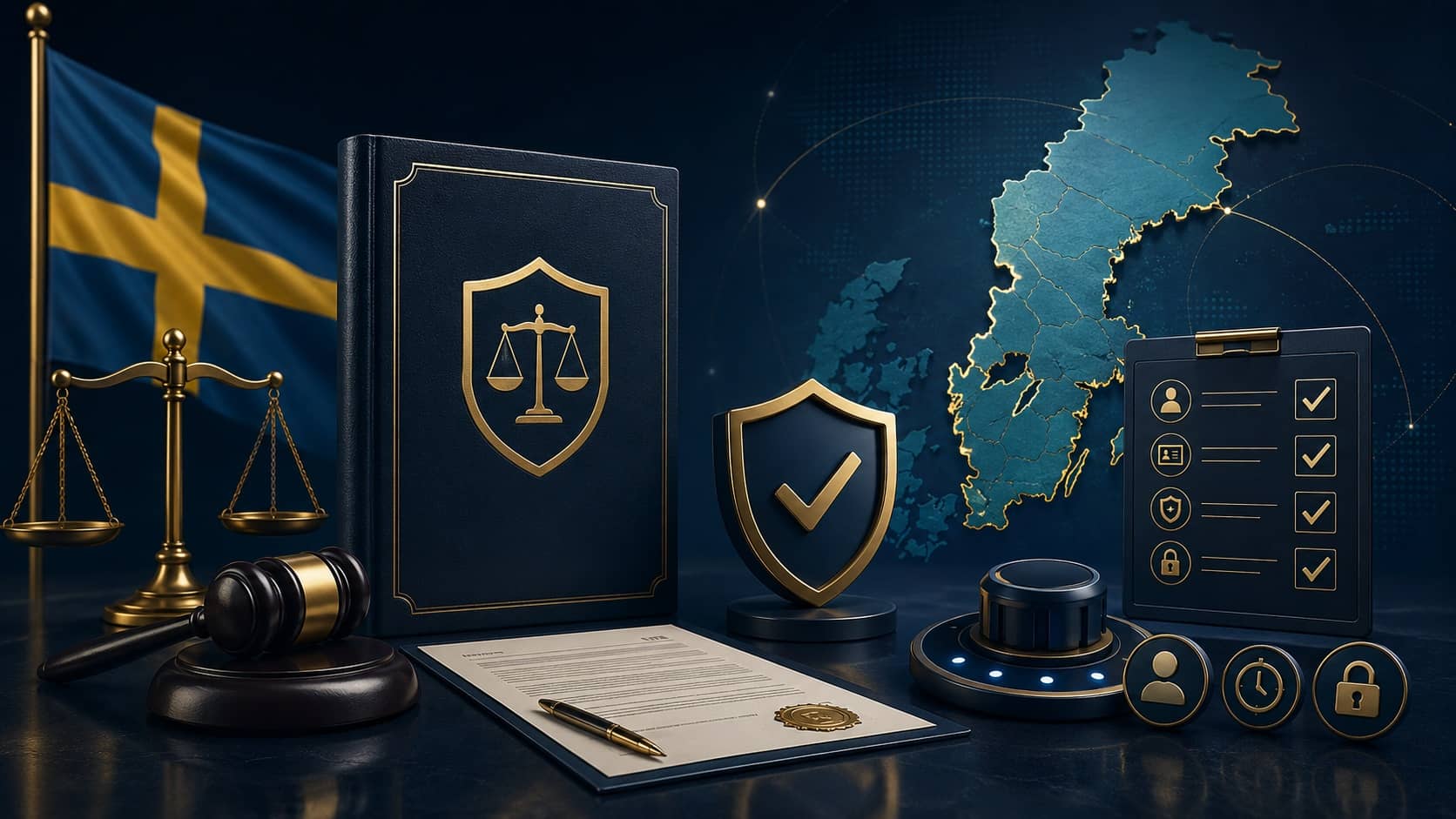
Sweden's modern gambling regime is, on paper, simple: a single statute, a single regulator, a small set of license categories. In practice it has acquired considerable detail over the past seven years. This page explains the framework as it stands in April 2026, with attention to the parts most often misunderstood by non-Swedish readers — the duty of care, the advertising regime, the credit ban, and the sanctions system.
This is editorial reference material, not legal advice. Where decisions or amounts matter, link directly to the underlying source — propositions and parliamentary committee reports are cited inline.
The framework at a glance
- Statute: Gambling Act (Spellagen, SFS 2018:1138)
- In force from: 1 January 2019
- Regulator: Spelinspektionen (Swedish Gambling Authority)
- License categories: commercial online gambling, betting, state lotteries, charity lotteries, restaurant casinos, software providers
- Land-based casino licensing: abolished from 1 January 2026
- Tax rate: 22% on operator gross gaming revenue
- Player tax: winnings from licensed operators are tax-free for the player
The 2018 Gambling Act
The Gambling Act (Spellagen, SFS 2018:1138) replaced Sweden's previous monopoly regime. Before 2019, casino gambling, lotteries, and most betting were operated by state-owned Svenska Spel and ATG. Online gambling was technically illegal for foreign operators to market to Swedish consumers, but enforcement was limited and a substantial unregulated market existed.
The 2019 reform took the position that a regulated, licensed market would produce better consumer outcomes than a monopoly. The Act sets out:
- License categories and application process (Chapters 4–11).
- Operator obligations including the duty of care (Chapter 14).
- Anti-money-laundering requirements.
- Marketing rules and the prohibition against targeting self-excluded players.
- Consumer protection: deposit limits, time limits, account closure rights.
- The supervisory role of Spelinspektionen.
- The penalty framework (Chapter 19): warnings, remarks, sanctions, license revocation.
A consolidated version is available at the Riksdag's document database, but only in Swedish. There is no official English translation of the Act.
License categories
Sweden uses a license-by-vertical model. An operator wishing to provide multiple types of gambling needs separate licenses for each.
| License type | What it covers | Notable holders |
|---|---|---|
| Commercial online gambling | Online casino, online poker, online bingo | LeoVegas, Betsson Group, Kindred, Casumo, Mr Green |
| Betting | Sports betting, betting exchanges | Bet365, Expekt, Unibet, Svenska Spel Sport |
| State lotteries | Reserved for state operator(s) | Svenska Spel |
| Charity lotteries | Lotteries for non-profit purposes | Postkodlotteriet, Bingolotto |
| Restaurant casinos | Limited table games in restaurants | Multiple small operators |
| Software providers | Game studios supplying licensed operators | Quickspin, Hacksaw Studios, Playson |
Land-based casino licensing was a separate category from 1999 to 2025. It was abolished from 1 January 2026 — see our dedicated page on Casino Cosmopol's closure.
The duty of care (omsorgsplikten)
Among Swedish gambling regulations, the most distinctive provision is the omsorgsplikt — the operator's duty of care toward the player. Codified in Chapter 14 of the Gambling Act, this duty obliges every license-holder to:
- Detect and intervene against problematic gambling, not merely facilitate self-exclusion when requested.
- Establish individualized risk assessments for each player based on activity patterns.
- Take active measures — temporary limits, contact, escalation to Spelpaus — when problematic patterns appear.
- Document the measures taken and their effects.
This is significantly stronger than the equivalent in many other licensed markets. UK and Maltese operators have responsible gambling obligations, but the Swedish framework places more weight on proactive operator action and is increasingly the basis of enforcement decisions. A meaningful share of recent Spelinspektionen sanctions cite duty-of-care failures.
The Spelpaus.se national self-exclusion register
Sweden operates a centralized self-exclusion register at spelpaus.se. A player can self-exclude for 1, 3, 6, or 12 months. Once registered, all licensed operators are technically prohibited from accepting deposits, sending marketing, or facilitating gameplay for that player. The system is operated by Spelinspektionen.
Spelpaus is consequential in enforcement terms. Operators that fail to respect a Spelpaus registration — through technical failure, marketing leakage, or improperly tagged accounts — are commonly subject to sanctions. The system also provides a meaningful enforcement signal that other markets lack: any player can verify their own status, and any breach is discoverable.
Marketing rules
Gambling advertising in Sweden is regulated under three overlapping regimes: the Marketing Act, the Gambling Act, and Konsumentverket's industry codes. The headline obligation is one of moderation (måttfullhet) — gambling marketing must not be intrusive, must not target vulnerable groups, and must include responsible gambling information.
Specific rules include:
- Advertising must include the operator's licensed status and a responsible gambling helpline.
- Marketing toward self-excluded players is prohibited.
- Welcome bonuses are restricted: a licensed operator may offer only one welcome bonus to each new player.
- Telephone marketing requires written consent from the recipient (since 1 June 2024).
- Advertising during live sports broadcasts is restricted by industry agreement.
These rules have been the subject of considerable enforcement activity. Konsumentverket has pursued operators in the Patent and Market Court, and several major rulings have established the boundaries of "moderation" in practice.
The credit ban
Sweden's gambling credit ban exists in two layers. The original 2019 prohibition barred license-holders from offering credit themselves. The extended ban in force from 1 May 2026 also bars license-holders from accepting credit-based third-party payments.
In practice, this means: an operator cannot accept payment from a credit card, a buy-now-pay-later service, or any other instrument where the player is borrowing money to fund the deposit. Debit cards, Swish, Trustly, BankID-based direct payments, and prepaid cards remain fully usable.
The amendment was introduced in government bill Prop. 2025/26:11 and confirmed by parliamentary committee report 2025/26:KrU3. The committee delayed the original 1 April 2026 effective date by one month to allow operators to implement the technical changes. For full detail, see our dedicated page Kreditkortsförbud casino 2026 (Swedish).
The sanctions framework
Spelinspektionen's enforcement powers are codified in Chapter 19 of the Gambling Act. The four levels are:
- Anmärkning (remark) — the lightest sanction, used for minor breaches.
- Varning (warning) — typically combined with a financial sanction (sanktionsavgift).
- Förbud (prohibition) — the operator may not provide gambling targeted at Sweden.
- Återkallad licens (license revocation) — used for serious or repeated breaches.
The financial sanctions can range from hundreds of thousands of kronor for technical breaches to tens of millions for systematic AML or duty-of-care failures. Decisions are routinely appealed to the administrative court (förvaltningsrätten) and onward to the higher administrative court (kammarrätten). A substantial share of recent decisions are pending appeal at any given time.
All decisions are public. Spelinspektionen publishes enforcement decisions and supervision updates on its official website. These should be checked directly for current status, especially where appeals may be involved.
Player taxation
Winnings from licensed operators are tax-free for the player in Sweden. This applies to all licensed verticals: casino, betting, lottery. Winnings from operators without a Swedish license, however, are subject to ordinary income tax. This is an additional reason — beyond regulatory protection — for Swedish players to use licensed operators.
Operators pay 22% tax on gross gaming revenue. This rate has been the subject of policy debate, with some industry voices arguing that a lower rate would improve channelization. The government has so far maintained the 22% level.
Player rights and dispute resolution
Sweden does not give Spelinspektionen authority to resolve individual player disputes. Instead, this falls to Allmänna reklamationsnämnden (ARN), the National Board for Consumer Disputes, which can examine disputes worth at least 750 SEK against any business including gambling operators. ARN's decisions are recommendations, not legally binding orders, but most licensed operators follow them.
The dispute pathway typically involves:
- Written complaint to the operator's customer service.
- Escalation to compliance / complaints department.
- Filing with ARN within one year of the original complaint.
- Optionally, civil court proceedings if ARN's recommendation is not followed.
For a detailed walkthrough of the dispute process, see our Swedish page Casino-tvist 2026 — så driver du ett ärende.
Recent legislative activity
The Gambling Act has been amended several times since 2019. Major changes:
| Year | Change |
|---|---|
| 2019 | Original Gambling Act takes effect; market opens to private operators. |
| 2021 | Bonus restrictions tightened; one welcome bonus only per operator per player. |
| 2023 | Match-fixing provisions strengthened; new reporting obligations. |
| 2024 | Telephone marketing requires written consent (from 1 June). |
| 2025 | Svenska Spel announced 25 April that Casino Cosmopol Stockholm was closed to guests and would not reopen (ownership instructions received 24 April); land-based casino license category abolished from 2026. |
| 2026 | Extended credit ban in force (1 May). |
Citation
If you cite this page, please use:
VinnaPengar.com (29 April 2026), "Sweden's Gambling Laws Explained", https://www.vinnapengar.com/en/swedish-gambling-laws-explained.html
The factual content is published under Creative Commons BY 4.0. You may reuse, adapt, and republish, including commercially, with attribution to VinnaPengar.com.
Read more: Swedish Gambling Market 2026 · Casino Cosmopol — end of land-based casinos · About the editorial team